Published by: U.S. Department of State, Office to Monitor and Combat Trafficking in Persons, 2007
Via: Docuticker
The Trafficking Victims Protection Reauthorization Act, passed by the Congress and signed into law by the President in December 2003, requires the Department of State to submit to the Congress an Interim Assessment of the progress made in combating trafficking in persons (TIP) by those countries placed on the Special Watch List in September 2006. The evaluation period covers the six months since the release of the June 2006 annual report.
This year, 39 countries are on the Special Watch List. These countries either (1) had moved up a tier in the 2006 TIP Report over the last year’s Report, or (2) were ranked on Tier 2 in the 2006 TIP Report, but (a) had failed to provide evidence of increasing efforts to combat TIP from the previous year, (b) were placed on Tier 2 because of commitments to carry out additional future actions over the coming year, or (c) had a significant or significantly increasing number of trafficking victims. Thirty-four of the 39 countries on the Special Watch List are in the second category–ranked as Tier 2 Watch List–including two countries initially ranked as Tier 3 in the June 2006 TIP Report, but reassessed as Tier 2 Watch List countries by the State Department in September 2006 (Belize and Laos). Attached to this Interim Assessment is an overview of the tier process.
Thursday, February 01, 2007


Friday, December 15, 2006
Holliday Season!
 Dear Readers
Yet another year has flown by. And it was a busy year indeed! I am going to take a well-deserved break, and will start posting again at breakneck speed in the New Year.
I hope that Gender Focus and its sister blogs have been of some help to you, and will continue to do so in the future. So look forward to a bumper crop of posts early in January 2007, as I will endeavor to bring you all up to speed with what has been happening over the holiday season.
Have a great time, and a Happy New Year!
Friday, December 01, 2006
Migration, human smuggling and trafficking from Nigeria to Europe
Looking at migration through the lens of Nigerian culture
By: Carling J
Published by: Noragric, Department of International Environment and Development Studies, Norwegian University of Life Sciences , 2006
Via: Eldis
This report contextualises the problems of migration, human smuggling and trafficking from Nigeria to Europe, focusing on cultural and social implications both within Europe and Nigeria. Some of the topics covered include:
By: Carling J
Published by: Noragric, Department of International Environment and Development Studies, Norwegian University of Life Sciences , 2006
Via: Eldis
This report contextualises the problems of migration, human smuggling and trafficking from Nigeria to Europe, focusing on cultural and social implications both within Europe and Nigeria. Some of the topics covered include:
- what is it about Nigeria: ethnic groups, regional and religious differences; gender and sexuality, trafficking in the region
- leaving Nigeria: hopes and opportunities; emigration and prostitution
- entering Europe: migration routes and transit stays; asylum application as a foothold
- Nigerians in Europe
The paper concludes that to understand the dynamics of Nigerian trafficking, various factors need to be taken into account. For example, many potential migrants enter into an emigration pact, which is perceived as a strongly binding agreement between two parties. This is sealed by religious rituals, as well as by the relation to the local community in Nigeria.
Tuesday, November 21, 2006
Trafficking in human beings and the 2006 World Cup in Germany
Draft Report
By: Hennig J, Craggs S, Larsson F & Laczko F
Published by: International Organization for Migraion (IOM), SIDA. September 2006
Prior to the World Cup in Germany in 2006, there was considerable international concern that this event would contribute to a sharp increase in trafficking for sexual exploitation. Media reports suggested that prostitution would increase and that up to 40,000 women might be trafficked. This report investigates whether the number of victims of human trafficking (VoT) for sexual exploitation increased during the World Cup 2006 in Germany. The study also examines the measures taken by the authorities and NGO community in Germany, before and during the World Cup to prevent human trafficking.
The study was conducted between June and September 2006. Research included a systematic review of media and statistical sources, an analysis of previous large-scale events and their impact on trafficking, and in-depth interviews with representatives of key agencies responsible for combating human trafficking in Germany. Sixteen in-depth interviews were conducted in total; with six experts from the relevant departments of German Länder Criminal Police Offices or the City Police Offices of selected World Cup Cities and ten in-depth expert interviews with civil society organisations (street work and assistance to victims of THB). In addition to the analysis of the situation in Germany, information on trends in connection with the World Cup was gathered in cooperation with IOM missions
By: Hennig J, Craggs S, Larsson F & Laczko F
Published by: International Organization for Migraion (IOM), SIDA. September 2006
Prior to the World Cup in Germany in 2006, there was considerable international concern that this event would contribute to a sharp increase in trafficking for sexual exploitation. Media reports suggested that prostitution would increase and that up to 40,000 women might be trafficked. This report investigates whether the number of victims of human trafficking (VoT) for sexual exploitation increased during the World Cup 2006 in Germany. The study also examines the measures taken by the authorities and NGO community in Germany, before and during the World Cup to prevent human trafficking.
The study was conducted between June and September 2006. Research included a systematic review of media and statistical sources, an analysis of previous large-scale events and their impact on trafficking, and in-depth interviews with representatives of key agencies responsible for combating human trafficking in Germany. Sixteen in-depth interviews were conducted in total; with six experts from the relevant departments of German Länder Criminal Police Offices or the City Police Offices of selected World Cup Cities and ten in-depth expert interviews with civil society organisations (street work and assistance to victims of THB). In addition to the analysis of the situation in Germany, information on trends in connection with the World Cup was gathered in cooperation with IOM missions
Tuesday, October 17, 2006
Poverty, gender and human trafficking in sub-Saharan Africa
 Rethinking best practices in migration management
By: Truong TD
Published by: United Nations Educational, Scientific and Cultural Organization (UNESCO) , 2006
Via: Eldis
This report critically analyses the linkages between poverty, gender and human trafficking in sub-Saharan Africa (SSA). The report asserts that poverty is one of the primary factors that cause people, particularly women and children, to become victims of trafficking. And because human trafficking keeps victims in poverty, a vicious circle of poverty-human trafficking-poverty is perpetuated. The author also states that even though human trafficking is currently a priority issue for many governments, it remains a subject that is poorly understood, and there is a dearth of information on the magnitude of the problem. Also, knowledge about the intersection between migration and trafficking has not yet brought about any consensus on the underlying forces and their implications for the wellbeing of children and women.
In addressing this issue, the report provides a gender critique of Structural Adjustment Programs (SAPs), which reveal how the lack of consensus on the relation between economic growth and poverty renders choices in collective action more vulnerable to error. This gender critique also highlights the negative effect of the dismantling of the care domain on livelihood systems in SSA, and how it exacerbates the pressure to migrate.
Also, the reports highlights a number of practices by organisations participating in the research, to point out how practices of migration management can benefit from a more holistic approach – one which addresses a broad set of overlapping livelihood systems. The organisations’ profiles, strengths, weaknesses, their understanding of trafficking and the replicability of their methods are presented.
Tuesday, October 10, 2006
Toolkit to combat trafficking in Persons
 Global programme against trafficking in Human Beings
Published by: United Nations Office on Drugs and Crime (UNODC), 2006
Via: Docuticker
The United Nations Office on Drugs and Crime today launched a toolkit to help Governments, policy-makers, law enforcement agencies and NGOs tackle human trafficking more effectively.
It contains practical tools for police and other law enforcement officers such as a checklist to help identify trafficking victims as well guidance on interviewing victims and victim protection.
The toolkit also outlines key aspects of a comprehensive response to human trafficking, such as the need to bring national legislation into line with international standards and strengthen international cooperation in criminal justice, including the extradition of criminals, seizure of assets and confiscation of the proceeds of crime.
UNODC Executive Director Antonio Maria Costa said robust international collaboration was essential in fighting trafficking. “Traffickers make a mockery of national borders. International cooperation is the basic condition for a successful response to human trafficking,” he said.
Monday, October 09, 2006
A profile of the world's young developing country migrants
Backround paper to the 2007 World Development Report
By: McKenzie, David J
Published by: World bank, 2006
Via: Docuticker
The paper uses individual level census and household survey data to present a rich profile of the young developing migrants around the world. Youth are found to comprise a large share of all migrants, particularly in migration to other developing countries, with the probability of migration peaking in the late teens or early twenties. The paper examines in detail the age and gender composition of migrants, whether young migrants move alone or with a parent or spouse, their participation in schooling and work in the destination country, the types of jobs they do, and the age of return migration.
The results suggest a high degree of commonality in the youth migrant experience across a number of destination countries. In particular, developing country youth tend to work in similar occupations all around the world, and are more concentrated in these occupations than older migrants or native youth. Nevertheless, there is also considerable heterogeneity among youth migrants: 29 percent of 18 to 24 year olds are attending school in their destination country, but another 29 percent are not working or in school. This illustrates both the potential of migration for building human capital, and the fear that lack of integration prevents it from being used.
By: McKenzie, David J
Published by: World bank, 2006
Via: Docuticker
The paper uses individual level census and household survey data to present a rich profile of the young developing migrants around the world. Youth are found to comprise a large share of all migrants, particularly in migration to other developing countries, with the probability of migration peaking in the late teens or early twenties. The paper examines in detail the age and gender composition of migrants, whether young migrants move alone or with a parent or spouse, their participation in schooling and work in the destination country, the types of jobs they do, and the age of return migration.
The results suggest a high degree of commonality in the youth migrant experience across a number of destination countries. In particular, developing country youth tend to work in similar occupations all around the world, and are more concentrated in these occupations than older migrants or native youth. Nevertheless, there is also considerable heterogeneity among youth migrants: 29 percent of 18 to 24 year olds are attending school in their destination country, but another 29 percent are not working or in school. This illustrates both the potential of migration for building human capital, and the fear that lack of integration prevents it from being used.
Thursday, October 05, 2006
Female Migrants: bridging the gaps throughout the life cycle
 Selected papers of the UNFPA-IOM Expert Group Meeting, New York, 2-3- May 2006
Published by: United Nations Population Fund (UNFPA), 2006
Via: Eldis
This is a collection of papers that came out of an expert group meeting organised by the UNFPA and IOM meeting on 2-3 May 2006 entitled “Female migrants: bridging the gaps throughout the life cycle”. The aim was to formulate a set of recommendations for action by governments, international organisations and civil society, as a contribution to the High-Level Dialogue on International Migration and Development to mainstream female migrants’ needs and rights into the agenda.
Various issues were discussed at the meeting, including the growing numbers of women migrants and the contribution they are playing in maintaining their families through remittances and the empowering potential of migration, and the negative aspects associated with migration, including trafficking and exploitation.
Friday, September 22, 2006
New in the Library
Getting to grips with trafficking
Reflections on human trafficking research in South Africa
ISS Monograph no. 123
By: Robyn Pharoah
Published by: Institute for Security studies, 2006
In this monograph the author presents an objective overview of what we know and what we dont know about human trafficking in South Africa and suggests the kinds of research which could be undertaken to fill the knowledge gap.
Reflections on human trafficking research in South Africa
ISS Monograph no. 123
By: Robyn Pharoah
Published by: Institute for Security studies, 2006
In this monograph the author presents an objective overview of what we know and what we dont know about human trafficking in South Africa and suggests the kinds of research which could be undertaken to fill the knowledge gap.
Wednesday, July 26, 2006
Focus 2006: crossing borders
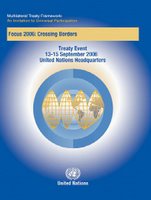
Multilateral treaty framework: an invitation to universal participation
Published by: United Nations, 2006
Via: UNPulse
Focus 2006: Crossing Borders (full text), a book about treaties being specially promoted for signature and ratification this year at September's High-Level Dialogue on International Migration and Development (Web site), is now online. The 30 treaties covered in the 156-page book, in French and English, cover a broad spectrum of migration-related issues: refugees and stateless persons; migrant workers and human rights; human security and trafficking in persons, and firearms; sustainable development, food security and ecological migration; and disarmament and State security. The book summarizes the objectives and key provisions of each treaty and, lists the Member States who had signed and ratified each as of 1 March 2006.
Tuesday, July 25, 2006
Trafficking in persons
Global patterns
Published by: United Nations Office on Drugs and Crime (UNODC), April 2006
Via: UNODC
The fact that slavery - in the form of human trafficking - still exists in the 21st century shames us all. Governments, international organizations and civil society are devoting considerable efforts to counter it, but there is still an information deficit about the extent of this tragedy. Only by understanding its depth, breadth and scope can we design policies to fight it. This understanding still eludes us: efforts to counter trafficking have so far been uncoordinated and inefficient. This Report by the United Nations Office on Drugs and Crime is our first attempt to close the knowledge gap
Published by: United Nations Office on Drugs and Crime (UNODC), April 2006
Via: UNODC
The fact that slavery - in the form of human trafficking - still exists in the 21st century shames us all. Governments, international organizations and civil society are devoting considerable efforts to counter it, but there is still an information deficit about the extent of this tragedy. Only by understanding its depth, breadth and scope can we design policies to fight it. This understanding still eludes us: efforts to counter trafficking have so far been uncoordinated and inefficient. This Report by the United Nations Office on Drugs and Crime is our first attempt to close the knowledge gap
Wednesday, July 05, 2006
Trafficking in persons report 2006

Best practices for implementing the Trafficking Victims Protection Act (TVPA)
Published by: US Department of State , 2006
Via: Eldis
This report is the sixth annual Trafficking in Persons (TIP) report issued by the US Department of State, aimed to assist the elimination of severe forms of TIP. In assessing foreign governments’ efforts, the TIP Report highlights the “three P’s”— prosecution, protection, and prevention. A victim-centred approach to trafficking is also used which equally to addresses the “three R’s”— rescue, rehabilitation, and reintegration.
The report also outlines best practices for implementing the Trafficking Victims Protection Act (TVPA) amended in 2000.
Tuesday, May 09, 2006
Trafficking in persons - Global patterns
Human Trafficking
Published by: Office on Drug and Crime (UNODC), 2006
Via: UN Pulse
Virtually no country in the world is unaffected by the crime of human trafficking for sexual exploitation or forced labour, a new report by the United Nations Office on Drugs and Crime (UNODC) released on the 24th of April shows. The report on Trafficking In Persons: Global Patterns (full text) identifies 127 countries of origin, 98 transit countries and 137 destination countries. It shows that global efforts to combat trafficking are being hampered by a lack of accurate data, reflecting the unwillingness of some countries to acknowledge that the problem affects them.
Published by: Office on Drug and Crime (UNODC), 2006
Via: UN Pulse
Virtually no country in the world is unaffected by the crime of human trafficking for sexual exploitation or forced labour, a new report by the United Nations Office on Drugs and Crime (UNODC) released on the 24th of April shows. The report on Trafficking In Persons: Global Patterns (full text) identifies 127 countries of origin, 98 transit countries and 137 destination countries. It shows that global efforts to combat trafficking are being hampered by a lack of accurate data, reflecting the unwillingness of some countries to acknowledge that the problem affects them.
Wednesday, April 12, 2006
Report on activities to combat human trafficking, Fiscal years 2001-2005

Combating Human Trafficking
Published by: U.S. Department of Justice, 2006
Via: ResoureShelf's DocuTicker
This report summarizes the Department's work during the fiscal years 2001-2005. Some of the accomplishments mentioned include an increase in prosecutions by more than 300%. Nearly 1000 human trafficking victims have been assisted, and since 2004, the Department has awarded grants totaling, more than $30 million to institute 32 multi-disciplinary anti-human trafficking task forces and 21 victim service providers in communities across the nation.
Tuesday, March 28, 2006
Describing the unobserved: methodological challenges in empirical studies on human trafficking
Improving methodological research on human trafficking
By: Tyldum G & Brunovskis A
Published by: Human Trafficking , 2005
Via: Eldis
In this paper the authors discuss the production of various types of data on human trafficking. The study analyses existing data and research, and suggests methods for improving enhanced data collection techniques and developing new methodologies. The authors also focus both on the development of estimates of victims of trafficking, as well as the production of data that describes the characteristics of this group. The discussion is based on a review of publications on trafficking for sexual exploitation in Europe as well as the authors’ own research, on transnational prostitution and trafficking in Oslo.
The authors conclude that, due to a lack of empirical knowledge about causes and mechanisms tied to trafficking, proxy (or process) indicators such as poverty, migration patterns, or missing persons have limited application for estimating size of the population of trafficking victims.
The authors also argue for the importance of conducting systematic research to collect accurate data on trafficked populations and call for further research asking the question is trafficking best understood as a phenomenon within the field of labour migration, international prostitution, or migration in general, or does trafficking constitute a distinct and separate phenomenon with its separate causes and mechanisms?
By: Tyldum G & Brunovskis A
Published by: Human Trafficking , 2005
Via: Eldis
In this paper the authors discuss the production of various types of data on human trafficking. The study analyses existing data and research, and suggests methods for improving enhanced data collection techniques and developing new methodologies. The authors also focus both on the development of estimates of victims of trafficking, as well as the production of data that describes the characteristics of this group. The discussion is based on a review of publications on trafficking for sexual exploitation in Europe as well as the authors’ own research, on transnational prostitution and trafficking in Oslo.
The authors conclude that, due to a lack of empirical knowledge about causes and mechanisms tied to trafficking, proxy (or process) indicators such as poverty, migration patterns, or missing persons have limited application for estimating size of the population of trafficking victims.
The authors also argue for the importance of conducting systematic research to collect accurate data on trafficked populations and call for further research asking the question is trafficking best understood as a phenomenon within the field of labour migration, international prostitution, or migration in general, or does trafficking constitute a distinct and separate phenomenon with its separate causes and mechanisms?
Thursday, March 23, 2006
Victims of trafficking for forced prostitution: protection mechanisms and the right to remain in the destination countries
Protecting the rights of trafficked victims
By: Simic O
Published by: Global Commission on International Migration , 2004
Via: Eldis
This study explores the right of trafficked victims of forced prostitution to remain in destination countries through the application of legal standards and victim protection mechanisms found at the national, regional and international level. The study also highlights the importance of State recognition that trafficked persons are victims of serious human rights abuses. Protecting the rights of trafficked victims.
It argues that States need to take steps to safeguard the legal rights and protective needs of trafficking victims regardless of their immigration status or willingness to cooperate with law enforcement officials. It considers the feasibility of the position that trafficked persons should have the right to temporary residence and work permits, thereby serving the dual interests of both enabling trafficked persons to recover and rebuild their lives, and enabling the effective prosecution of traffickers by encouraging victims to report to the authorities and to act as witnesses.
By: Simic O
Published by: Global Commission on International Migration , 2004
Via: Eldis
This study explores the right of trafficked victims of forced prostitution to remain in destination countries through the application of legal standards and victim protection mechanisms found at the national, regional and international level. The study also highlights the importance of State recognition that trafficked persons are victims of serious human rights abuses. Protecting the rights of trafficked victims.
It argues that States need to take steps to safeguard the legal rights and protective needs of trafficking victims regardless of their immigration status or willingness to cooperate with law enforcement officials. It considers the feasibility of the position that trafficked persons should have the right to temporary residence and work permits, thereby serving the dual interests of both enabling trafficked persons to recover and rebuild their lives, and enabling the effective prosecution of traffickers by encouraging victims to report to the authorities and to act as witnesses.
Thursday, February 02, 2006
Rethinking masculinity: educating young men to reduce the demand side of trafficking
Challenging male perceptions of trafficking in women
By: Coalition Against Trafficking in Women – Asia Pacific; Enriquez J
Published by: The Coalition Against Trafficking in Women – Asia Pacific (CATW-AP) , 2005
Via: Eldis
This practical guide outlines the challenges faced in changing male perceptions of paid sex with women. The document provides details of a three day course run by the Coalition Against Trafficking in Women which aimed to provide young men with a critical understanding of violence against women, particularly prostitution, and move towards a change of attitude and treatment of women.
The guide also focuses on the production of teaching materials and options available for resourcing the education aspect of a programme. These include flipcharts, comics and flyers on prostitution. Insights are offered into the results of the example camp and the affect that this had on the male participants. The document further outlines how the camp was set up and the different sectors of society that participants were recruited from.
By: Coalition Against Trafficking in Women – Asia Pacific; Enriquez J
Published by: The Coalition Against Trafficking in Women – Asia Pacific (CATW-AP) , 2005
Via: Eldis
This practical guide outlines the challenges faced in changing male perceptions of paid sex with women. The document provides details of a three day course run by the Coalition Against Trafficking in Women which aimed to provide young men with a critical understanding of violence against women, particularly prostitution, and move towards a change of attitude and treatment of women.
The guide also focuses on the production of teaching materials and options available for resourcing the education aspect of a programme. These include flipcharts, comics and flyers on prostitution. Insights are offered into the results of the example camp and the affect that this had on the male participants. The document further outlines how the camp was set up and the different sectors of society that participants were recruited from.
Thursday, January 19, 2006
Maid to order: ending abuses against migrant domestic workers in Singapore

Women domestic workers in Singapore suffer grave abuses
Published by: Human Rights Watch (HRW) , 2005
Via: Eldis
This report presents research carried out on the abusive conditions facing many domestic workers in Singapore. It suggests that many women domestic workers face poor working conditions, anxiety about debts owed to employment agencies, social isolation, and prolonged confinement indoors, sometimes for weeks at a time.
The Singapore government to date has relied on market forces rather than laws to regulate key labour issues for domestic workers such as charges imposed by employment agencies, wages, and weekly rest days. As a result, a migrant domestic worker’s fate in Singapore is highly variable. The report also finds that the Singapore government has instituted several policies that exacerbate domestic workers’ isolation in homes and their risk of abuse. Whilst in response to growing publicity and alarm over abuses against migrant domestic workers, Singapore’s Ministry of Manpower has instituted some encouraging reforms in the past two years, these initiatives, though important, do not go far enough. Singapore needs to do more to address the underlying inequities and lack of protection that result in widespread abuse.
Monday, January 09, 2006
A new blog on Same-Sex Marriage
Dear Readers
In the light of the recent developments regarding Same-Sex Marriage in South Africa, I have added another blog to my little family. It will deal with all matters relating to Same-Sex Marriage, especially regarding legislation.
A link to it has been added in the breadcrumb, and several links to informative websites have been added to the link menu
In the light of the recent developments regarding Same-Sex Marriage in South Africa, I have added another blog to my little family. It will deal with all matters relating to Same-Sex Marriage, especially regarding legislation.
A link to it has been added in the breadcrumb, and several links to informative websites have been added to the link menu
On the agenda: older migrant women

Facts, figures, personal stories: an inventory in five EU Countries
Produced by: AGE+ , 2005
Via: Eldis
This reports summarises key findings on the situation of older migrant women in the five participating countires of the AGE+ project - the United Kingdom, Austria, Germany, The Netherlands and Italy.
The report argues that older migrant women belong to a vulnerable group. Statistically they are hardly visible and their lives go practically unnoticed. The results of the research that does exist do not render a positive image. Because of their limited possibilities at the labour market, low incomes and insufficient pensions, migrant women are at risk of spending their retirement in poverty. Along with the feminisation of poverty, there is now a high risk of the colouring of poverty.
Subscribe to:
Posts (Atom)


